De-scoping PCI through orchestration and independent token vaults
Achieving PCI-DSS compliance remains a significant challenge for any growing business. Expensive external audits and security assessments are the obvious visible costs, but managing all raw card data internally comes with a massive operational drag and ties merchants to a rigid security infrastructure. The most effective way to eliminate this PCI burden is by ‘de-scoping’ your environment entirely.
In this blog, we’ll explain how pairing payment orchestration with an independent token vault keeps sensitive data off your servers while unlocking true, long-term payment infrastructure independence.
The hidden operational costs of PCI scope
To understand why de-scoping is so critical, you have to know how card data behaves once it enters your environment. Raw payment data rarely stays in one place. It propagates.
When you manage raw card data internally, every server, database, and application that touches a Primary Account Number (PAN) is pulled into your PCI compliance boundary. The more card data flows through your business, the more systems fall into PCI scope. This adds operational complexity and increases the level of risk inside your own environment, and liability tied to every transaction you process.
Raw PANs are highly sensitive data, and if those systems are compromised, the consequences can be severe: regulatory fines, mandatory forensic investigations, operational disruption, and damaged customer trust.
This is why the goal is to reduce this burden entirely through ‘PCI de-scoping' - shrinking your compliance footprint by ensuring your servers never touch the PAN. Removing the PAN from your environment means that the strictest PCI rules no longer apply to your core payment infrastructure, which drops your requirements from a SAQ D assessment down to a highly simplified SAQ A.
How you reduce PCI scope matters just as much, if not more. The most effective way to stop data propagation and de-scope your environment is through tokenisation. However, while it can fix one compliance problem, the wrong setup can create a host of other operational challenges down the line.
PSP-Native Tokenisation
At first, relying on your primary Payment Service Provider (PSP) for tokenisation might look like the simplest solution. It is often a quick, low-effort fix to check the PCI compliance box, and it may even work well initially for merchants with a single provider, one region, and a narrow use case.
However, turning to tokenisation as a short-term convenience might lead to long-term strategic liabilities. When you use a PSP-native vault, the PSP takes ownership of your customer tokens, pulling your sensitive data into a closed ecosystem. This creates a form of vendor lock-in with downstream consequences for your business:
- If they go down, you go down: Since all your saved customer cards are locked in your chosen PSP system, you can't just switch to a backup provider. If their system breaks, your checkout breaks, resulting in a poor payment experience and potential revenue loss.
- Unnecessary Costs: Without independent control of your tokens, you are unable to route your transactions to the most cost-effective processors. You are forced to accept whatever fixed fees your single provider decides to charge. You may also miss out on the lower-cost options and higher authorisation rates that come from other token types.
- Stunted Growth and Expansion: You're completely reliant on your provider’s roadmap. If you want to expand to a new country and need a local payment method that they don't offer, you're stuck. And because your provider holds your customer data, trying to switch to a better partner can be painful.
Ultimately, while a PSP-native model offers immediate convenience, the trade-off is total dependency. To truly protect your revenue and keep your options open, you need to own your own customer data.
Independent Token Vault
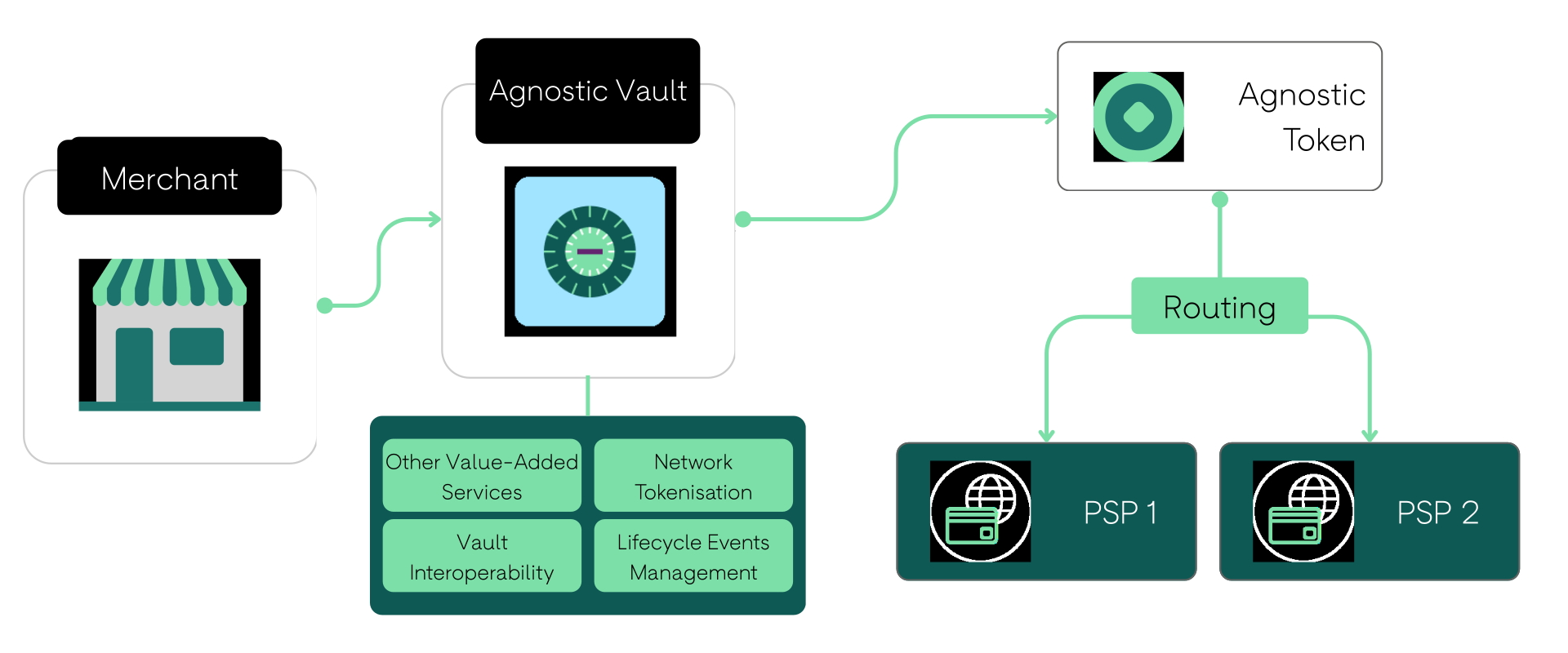
An agnostic, standalone token vault operates on a completely different model than a PSP-native solution. It acts as “one chip for every table” - the tokens are PSP-agnostic and fully owned by you. This means they can be translated, routed, and used across any PSP, gateway, or acquirer without being tied to a single provider, giving you more freedom in building a resilient, multi-processor setup.
When a customer enters their payment details, their raw data is placed in a secure, PCI-compliant vault and replaced with a universal token. Your internal servers never touch the sensitive data, therefore shrinking your PCI liability significantly and neutralising the threat of data breaches. If cybercriminals break into your system, they only find meaningless numbers that cannot be reverse-engineered, decrypted or monetised.
Orchestration combined with Tokenisation
It’s important to understand how your token strategy shapes payment performance. This independence is powerful on its own, but it becomes truly transformative when combined with agnostic payment orchestration. An orchestration platform, like BR-DGE, acts as the intelligent routing layer between your checkout or cashier, the secure vault, and your payment providers - ensuring the right token gets to the right place, via the best route, instantly.
Complete token ownership also puts you back in charge of your margins. You can leverage orchestration to automatically send every single transaction to the lowest-cost provider, or the route that is most likely to authorise the transaction, based on card type, transaction value, or region. Instead of accepting uncompetitive flat rates, you can make providers compete for your volume.
It also keeps your payments moving when things go wrong. If a PSP experiences downtime, your orchestrator simply routes the transaction to a backup using the same token. Your checkout stays online, and your customers never notice a glitch.
Short-term convenience versus long-term control is the right way to think about it.
Strategic flexibility and future-proofing
Having a token strategy goes far beyond checking boxes for a compliance auditor. When you de-scope using an independent vault and orchestration, you also future-proof your business against an ever-changing digital landscape. Yet, only 12% of merchants claim to have fully interoperable vaulting in place.
Keeping all your customer payment details in one unified vault, instead of jumping between different fragmented PSP dashboards, streamlines your team’s workload and makes tracking your money much easier. But the real power is portability.
When you own your data and control a central, agnostic token vault, you benefit from the interoperability effect. It removes the technical barriers to expansion, allowing you to easily plug the best acquiring banks, local payment methods, and top-tier fraud tools into one seamless ecosystem, without having to rebuild your setup or ask your current provider for permission.
A standalone vault also gives you direct access to scheme-level innovations like Network Tokenisation and Account Updater services. This means expired, lost, or stolen cards are automatically updated in the background directly by the card networks (Visa, Mastercard). Customers get a seamless, uninterrupted experience, and you see higher authorisation rates, fewer failed transactions, and a drastic reduction in involuntary churn.
What merchants should evaluate next
For merchants thinking about de-scoping PCI, the decision on the tokenisation strategy will directly impact the revenue, cost structure, and the ability to adapt to new market conditions. It is not a decision that should be left solely to the compliance team, but considered a fundamental business architecture choice.
As you evaluate your PCI de-scoping options, you need to ask yourself three critical questions:
- Who actually owns my customer payment data? If you decide to leave your current PSP tomorrow, can you take your recurring billing tokens with you, or will you have to ask your customers to re-enter their card details?
- What happens to my checkout if my primary provider goes down? Do you have the ability to instantly route volume to a backup acquirer, or are you entirely reliant on a single point of failure?
- Can you adapt to market changes without a massive engineering lift? Based on your current payment architecture, are you better off sticking with PSP-native tokenisation, or should you consider a standalone, agnostic solution?
If those answers point to a tightly coupled environment, there is a strong case for rethinking the architecture. For many merchants, the goal should be simple: keep card data out of internal environments, reduce the number of systems in PCI scope, and build a payment stack that can adapt as the business grows.
Tokenisation helps you reduce compliance burden. Paired with orchestration, it empowers you to build a cleaner, more resilient, more adaptable payments foundation. And in a market where flexibility matters more every year, that is a practical advantage worth taking seriously.
Ready to simplify your PCI scope and take control of your tokenisation strategy? Get in touch with the BR-DGE team today to discuss how an independent token vault can work for your business.
Related content